Is It Worth It to Repair My Old Vehicle or Just Dispose of It?
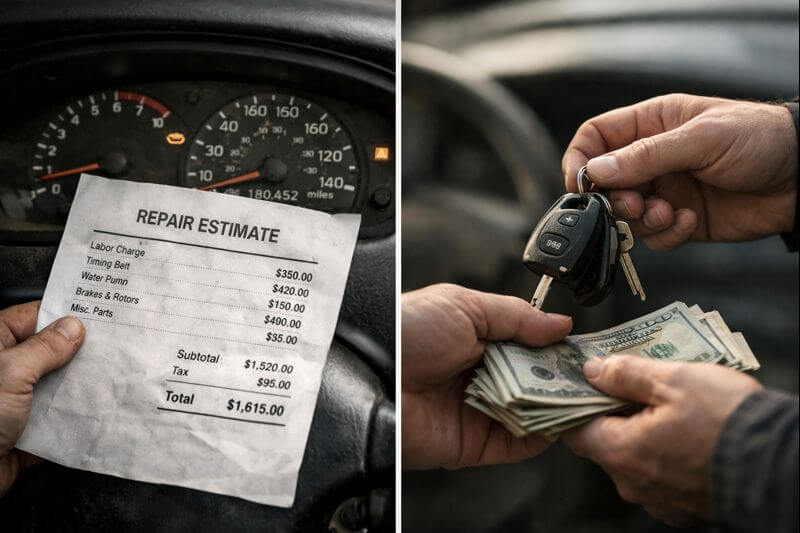
You’re staring at a repair estimate that makes your stomach drop. $2,800 to replace the transmission. Or maybe it’s $1,500 for a head gasket. Your car has 180,000 miles on it, the paint is fading, and you’ve already sunk money into it this year. Now you’re asking yourself the question every car owner eventually faces: Is this thing even worth fixing anymore?
I’ve been on both sides of this conversation—as a mechanic delivering bad news and as a car owner holding that crumpled estimate in my hand. After fifteen years in the automotive industry, I can tell you this: there’s no universal answer, but there is a clear way to think through it. This decision isn’t just about math. It’s about understanding what your car is really worth, what you’re actually paying for, and whether you’re throwing good money after bad.
Let’s walk through this together.
What Is Your Car Really Worth?
Before you decide anything, you need to know what you’re working with. Not what your car was worth when you bought it, and not what you hope it’s worth—what it’s actually worth right now, today, in the condition it’s in.
Check the private party value. Go to Kelley Blue Book, Edmunds, or NADA Guides. Be honest about the condition. Select “Fair” if there are cosmetic issues or minor mechanical problems. Don’t select “Good” just because you love the car. This isn’t about pride—it’s about reality.
Let’s say your 2012 Honda Accord with 185,000 miles is worth $4,200 in fair condition. That’s your baseline number. Everything else we discuss will reference this figure.
Now consider what it’s worth broken. If the car isn’t running or needs major work, you’re looking at scrap value or as-is selling price. Scrap yards typically pay $200–$600 depending on weight and current metal prices. You might get $800–$1,500 selling it as-is to someone who wants a project car or needs parts. These are your disposal options.
Here’s the uncomfortable truth: if your repair estimate approaches or exceeds 50% of your car’s current market value, you’re entering the danger zone. That doesn’t automatically mean don’t repair it—but it does mean you need to think very carefully about what comes next.
When Repairing an Old Vehicle Makes Sense
Let me be clear: sometimes fixing an old car is absolutely the right call. I’ve seen people get another 80,000 miles out of vehicles after a major repair. Here’s when it makes financial and practical sense.
The repair is minor to moderate. You’re looking at $300–$800 for brakes, a starter, an alternator, or a water pump. These are maintenance items. They wear out. If the rest of the car is solid, fix it and move on. A $500 repair on a car worth $4,000 is a no-brainer—you’ll never replace that car for $500.
The vehicle has been well maintained. If you’ve kept up with oil changes, transmission fluid, coolant flushes, and routine maintenance, your car has earned the benefit of the doubt. A well-maintained 15-year-old car with 180,000 miles can be more reliable than a neglected 8-year-old car with 90,000 miles. I’ve seen this play out hundreds of times.
It’s a single major failure, not a pattern. One big repair? Okay, that happens. Cars have parts that eventually fail. But if you fixed the transmission last year, the engine mounts six months ago, and now the head gasket is blown, that’s a pattern. Patterns mean the car is dying, and you’re just choosing how slowly.
You genuinely can’t afford a replacement. Here’s the reality: if you don’t have $5,000–$8,000 for a decent used car and you can’t get financing, a $2,000 repair might be your best option—even if it’s not ideal. Just understand you’re buying time, not solving the problem forever. Budget for the next issue.
The car meets your needs and you plan to drive it into the ground. Some people don’t care about resale value because they plan to drive the car until it literally won’t run anymore. If that’s you, and the repair keeps it going another year or two, the cost-per-month breakdown might work in your favor. A $2,000 repair that gives you 18 more months is $111/month—cheaper than most car payments.
When Disposal Is the Smarter Choice
Now let’s talk about when it’s time to let go. This is where people make expensive mistakes because they let emotion override logic.
The repair cost exceeds the car’s value. If your car is worth $3,500 and the repair is $4,200, you’re upside down before you even turn the key. You’ll have invested $4,200 into a vehicle you could sell for $3,500—assuming nothing else breaks. That’s a guaranteed loss, and cars this old always have something else that breaks.
You’re experiencing cascading failures. Transmission dies. You fix it. Two months later, the AC compressor fails. You fix it. Then the catalytic converter goes. This is the car telling you it’s done. When multiple major systems start failing in succession, you’re not repairing a car—you’re funding a mechanical hospice program.
The repair is catastrophic. Engine replacement: $3,500–$6,000. Transmission rebuild: $2,200–$4,500. These repairs on a car worth $4,000 or less rarely make sense unless you’re deeply attached or have very specific circumstances. The math just doesn’t work.
Safety systems are compromised. If the frame is rusted through, if the suspension is dangerously worn, if the airbag system is malfunctioning and expensive to fix—these aren’t minor issues. They’re safety hazards. No amount of sentimental value is worth risking your life or someone else’s.
You’ve already exceeded the 50% rule multiple times. You fixed the engine last year for $3,000. Now you’re looking at another $2,500 for suspension work. At some point, you’re not maintaining a car—you’re repeatedly buying the same depreciating asset. Step back and look at your total repair spending over the last 12–24 months. If it exceeds the car’s current value, you’re losing.
The car is unreliable and costing you money in other ways. Missing work because your car won’t start. Uber rides while it’s in the shop. Towing fees. Rental cars. These hidden costs add up fast. A car that breaks down frequently isn’t just expensive to repair—it’s expensive to own.
Cost Comparison Breakdown: The Real Numbers
Let’s make this concrete with a realistic scenario. You own a 2011 Toyota Camry with 190,000 miles. Private party value: $4,500. The transmission is slipping, and you need a rebuild. Estimate: $3,200.
Option 1: Repair it
- Repair cost: $3,200
- Total invested: $3,200
- What you have: A 14-year-old car worth $4,500 (if nothing else breaks)
- Monthly cost if it lasts 18 months: $178/month
- Risk: High. Transmission failure at this mileage often signals other systems are near end-of-life.
Option 2: Sell it as-is
- As-is selling price: $1,200–$1,800
- Use that toward replacement
- Buy a $6,000 used car (2015–2017, 80,000–100,000 miles)
- Out-of-pocket after sale: $4,500–$5,000
- What you have: A newer car with less mileage and likely fewer immediate problems
Option 3: Scrap it
- Scrap value: $300–$500
- Buy a $6,000 used car
- Out-of-pocket after scrap: $5,500–$5,700
- What you have: Same as Option 2, but you got less for your old car
The break-even question: If you repair for $3,200, how long does the car need to last to make it worth it compared to replacement?
If a replacement car costs you $5,000 out-of-pocket (after selling yours as-is for $1,500), you’d save $1,800 by repairing instead. To justify that repair, your car needs to last at least 12–18 months without major additional expenses. If it lasts 24 months, you come out ahead. If it needs another $1,500 repair in 6 months, you’ve lost.
This is the gamble. And with high-mileage cars, the house usually wins.
Decision Checklist: Should I Repair or Dispose?
Use this framework. Answer honestly.
Consider repairing if:
- ✓ Repair cost is less than 50% of car’s current value
- ✓ The car has been well maintained with documented service history
- ✓ This is an isolated failure, not part of a pattern
- ✓ The rest of the car is in good condition (no rust, good tires, working AC/heat)
- ✓ You plan to keep it at least 12–24 more months
- ✓ You can’t afford to replace it right now
- ✓ A trusted mechanic says the repair will genuinely extend the car’s life
Consider disposal if:
- ✓ Repair cost exceeds 75% of the car’s value
- ✓ You’ve had two or more major repairs ($1,000+) in the past 12 months
- ✓ The car is unreliable and leaves you stranded regularly
- ✓ Safety systems are compromised (frame damage, failed airbags, brake system issues)
- ✓ You have access to financing or savings for a replacement
- ✓ The car has over 200,000 miles and multiple systems are showing wear
- ✓ Your mechanic is hesitant and says “I can fix it, but I can’t promise it won’t have other issues soon”
Still unsure? Get a pre-repair inspection. For $100–$150, a good mechanic will do a comprehensive check and tell you everything else that’s wrong or close to failing. If that list is long and expensive, you have your answer.
Common Mistakes Car Owners Make
I’ve watched people make the same errors over and over. Avoid these.
The sunk cost fallacy. “I’ve already put $4,000 into this car over the past two years, so I have to keep fixing it.” No, you don’t. That $4,000 is gone. It’s not coming back. The only question that matters is: does spending more money make sense going forward? Past spending is irrelevant to that decision.
Overestimating resale value. Your car is not worth what you paid for it. It’s not worth what it was worth three years ago. It’s worth what someone will pay for it today. Check actual listings—not just valuation guides. See what similar cars in similar condition are selling for in your area. Be realistic.
Fixing the car before selling. Unless it’s a minor repair (under $300) that significantly increases sale price, don’t fix a car you’re planning to sell. Sell it as-is. You will never recoup the full repair cost in resale value. Buyers discount pre-sale repairs because they assume you’re hiding something worse.
Ignoring the total cost of ownership. You’re not just paying for the repair. You’re paying for higher insurance (older cars sometimes cost more to insure if they lack safety features), worse fuel economy, the stress of unreliability, and the risk of another breakdown. Add it all up.
Listening to the wrong people. Your cousin who “knows cars” because he changed his own oil twice is not a qualified advisor. Neither is the internet forum where everyone insists their 1997 Civic will run forever. Get advice from an actual mechanic who has no financial stake in your decision.
Letting emotion drive a financial decision. I get it. This was your first car. Your dad gave it to you. You drove your kids home from the hospital in it. That matters—but it doesn’t change the math. If you want to keep it for sentimental reasons, fine, but acknowledge that’s what you’re doing. Don’t pretend it’s the smart financial move when it isn’t.
What About Environmental Impact?
There’s a common belief that keeping an old car running is better for the environment than scrapping it and buying something newer. The reality is more nuanced.
Manufacturing impact is real. Building a new car does have significant environmental cost—mining materials, manufacturing, shipping. If your old car runs well and gets decent mileage, keeping it can be the greener choice.
But efficiency matters more than age. A 2010 car averaging 18 MPG versus a 2018 car getting 32 MPG? The newer car will offset its manufacturing carbon footprint in just a few years through better fuel efficiency. Older cars also tend to have failing emissions systems—catalytic converters wear out, sensors fail, engines run rich. They pollute more than you think.
Proper disposal is actually responsible. Modern auto recycling recovers about 80% of a vehicle’s materials. Steel, aluminum, copper, and glass are all recycled. Fluids are properly disposed of. Scrapping a dying car isn’t environmentally reckless—abandoning it or keeping it running while it spews pollutants is worse.
If environmental impact is your concern, the best move is keeping a well-maintained, fuel-efficient car running as long as possible—then properly recycling it when it’s truly done and replacing it with something more efficient.
Alternatives to Scrapping
Disposal doesn’t always mean the scrap yard. You have options.
Sell it as-is. List it on Facebook Marketplace, Craigslist, or OfferUp. Be honest about the issues. Someone who does their own repairs or needs a parts car will often pay more than scrap value. I’ve seen non-running cars sell for $1,500 when scrap would’ve paid $400.
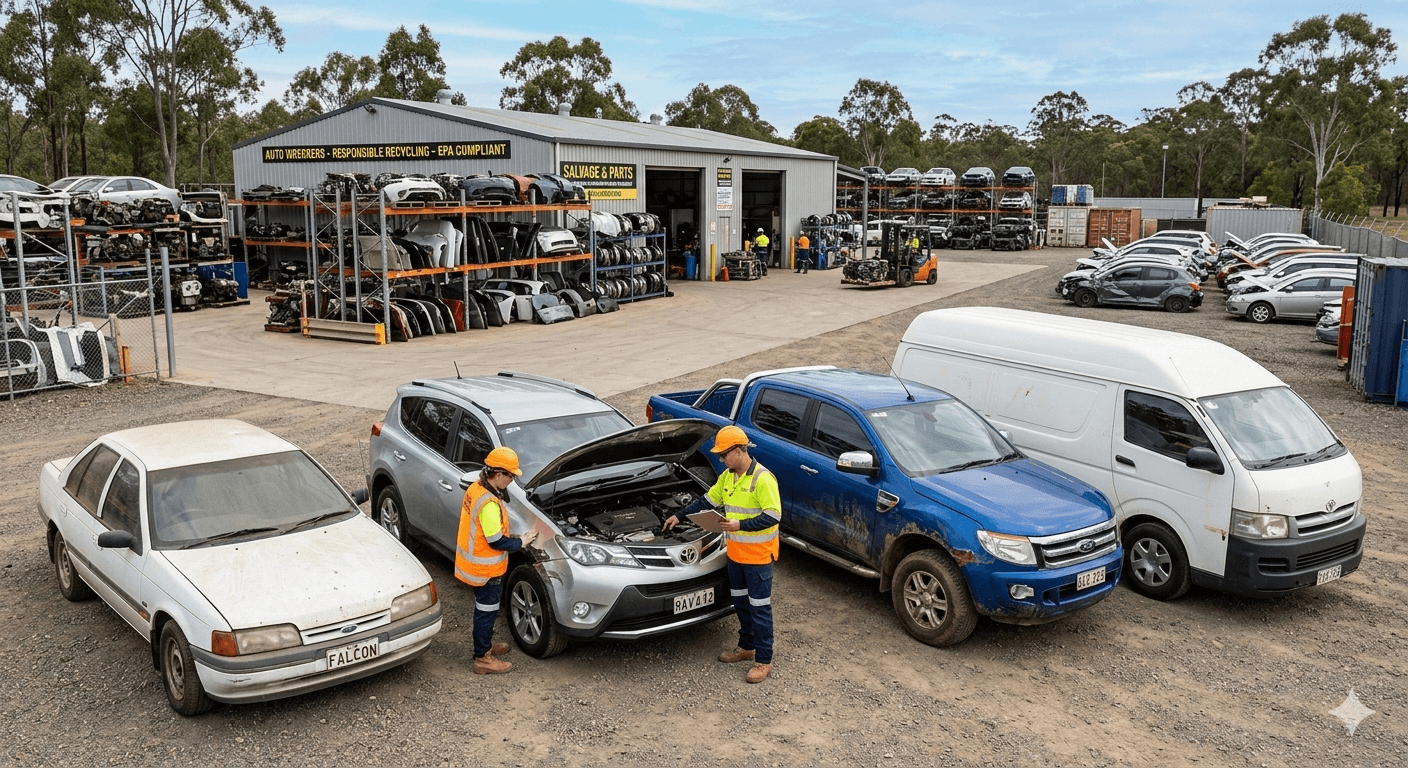
Part it out. If you have time and space, you can remove valuable parts (headlights, wheels, infotainment system, engine components if they’re still good) and sell them individually. This takes effort but can yield $800–$2,000 more than scrapping. Then scrap what’s left.
Donate it. Charities like Kars4Kids or Goodwill will take your car, running or not. You get a tax deduction (usually equal to what they sell it for at auction, often $500–$1,500). Not as much cash as selling, but it’s easier and you’re supporting a cause.
Trade it in. Dealerships will give you something for it, even if it’s broken. Trade-in value on a non-running car is usually low ($300–$800), but it’s instant and requires zero effort. They handle the paperwork and towing.
Frequently Asked Questions
How much is too much to spend on repairing an old car?
As a general rule, if a single repair costs more than 50–75% of your car’s current market value, it’s too much—especially if the car has high mileage or a history of problems. There are exceptions (well-maintained cars, can’t afford replacement), but that’s your threshold for serious reconsideration.
Should I fix my car before selling it?
Almost never. Buyers discount pre-sale repairs because they assume you’re covering up bigger issues. Sell it as-is and let the buyer decide what they want to fix. You’ll rarely recoup the repair cost in sale price. The exception: very minor, cheap fixes (under $200) that make the car significantly more presentable.
Is scrapping my car bad for the environment?
No. Modern auto recycling is highly efficient, recovering about 80% of materials. What’s worse for the environment is keeping a poorly maintained, inefficient car running when it’s failing emissions standards and burning oil. Scrapping and replacing with something more efficient is often the greener choice.
Can I drive my car if it needs a major repair?
Depends on the repair. Bad alternator? You’ll get stranded. Failing transmission? You might cause more damage driving it. Worn brakes? You’re risking your safety and others’. Ask your mechanic specifically: “Is it safe to drive, and will driving it make the problem worse?” Don’t guess.
What if I still owe money on the car?
If you owe more than the car is worth (you’re upside down), disposal gets complicated. You’ll need to pay off the remaining loan balance even after selling or scrapping. Talk to your lender about your options. Sometimes rolling negative equity into a new loan makes sense; sometimes it doesn’t. Get financial advice before deciding.
Conclusion
Repair your old car if the cost is reasonable (under 50% of its value), the vehicle has been reliable, and you’ll get meaningful time from the fix. Dispose of it when repair costs spiral, breakdowns become frequent, or safety is compromised. Strip away the emotion and run the numbers honestly. Calculate what you’re really spending versus what you’re getting back. Trust your mechanic’s assessment, but verify with a second opinion on major work. There’s no one-size-fits-all answer—only what makes sense for your budget, timeline, and peace of mind. Make the decision confidently, then move forward without regret.